
Written By: Gary Hite, Research Content Writer
Reviewed By: Natalie Kunsman, M.D., Board-Certified Physician
Last Reviewed: September 4, 2026
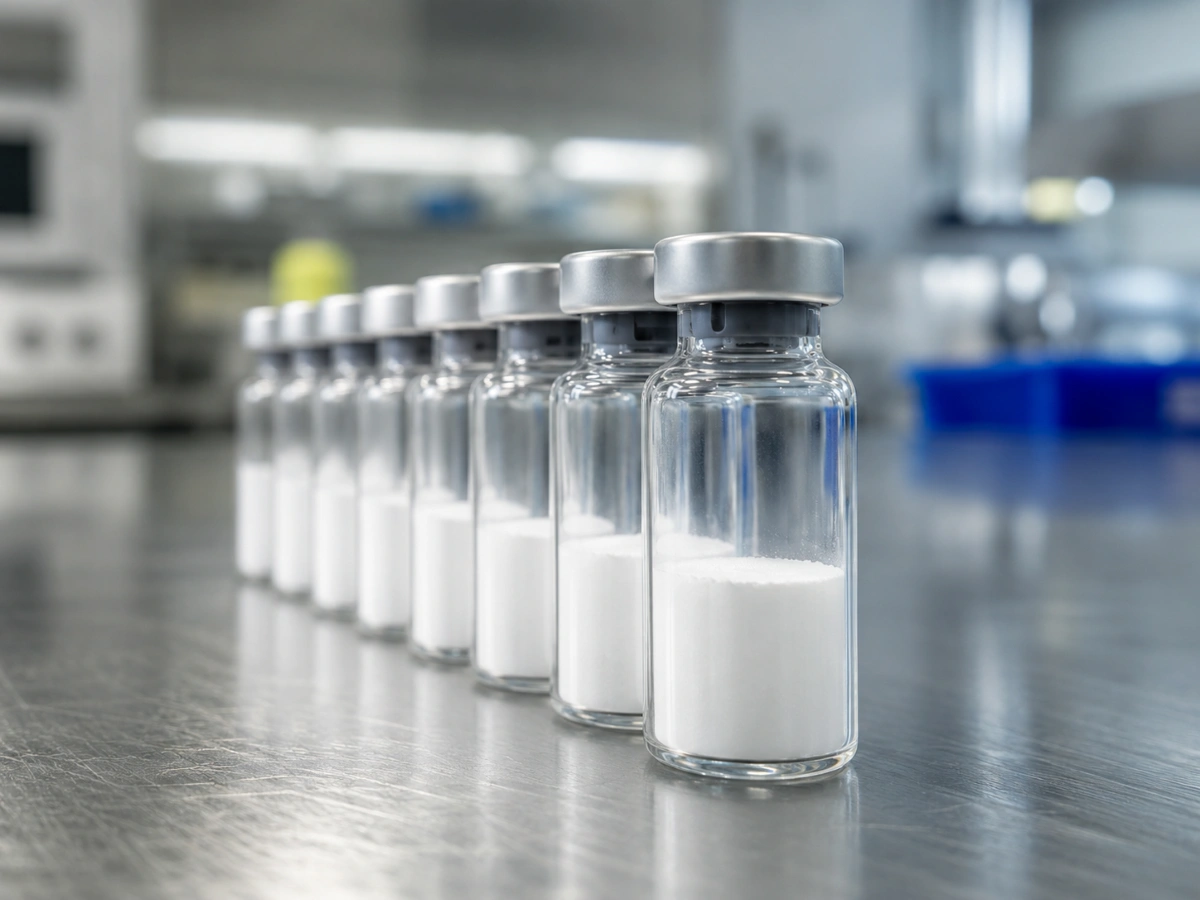
Recombinant human growth hormone (recombinant HGH) is one of the most extensively characterized recombinant proteins in the biophysical and protein chemistry literature, which makes it a frequent reference molecule in laboratory studies of protein degradation. Teams that browse research peptides for laboratory work need to understand how this material behaves under different storage conditions, because that behavior is central to generating reproducible data. This article examines the two degradation pathways that most often compromise recombinant HGH preparations in the laboratory, physical aggregation and chemical deamidation, then reviews the storage variables that govern these processes and the analytical tools used to track them.
Important notice: The information below is provided strictly for educational and research purposes. Recombinant HGH discussed here is intended for in vitro and laboratory research use only. It is not for human or animal consumption, not for diagnostic use, and not for any clinical, therapeutic, or personal application. This article makes no medical claims and does not describe or endorse any use in living subjects.

Understanding Recombinant HGH as a Research Protein
Recombinant HGH is a single-chain polypeptide composed of 191 amino acid residues, with a molecular mass of roughly 22 kDa. Its tertiary structure is organized around a four-helix bundle and is stabilized by two intramolecular disulfide bonds. Several structural features make it a useful and instructive subject for stability research.
The molecule carries solvent-exposed hydrophobic surfaces and flexible loop regions that can sample partially unfolded states under stress. It also contains specific labile residues, including asparagine sites prone to deamidation and methionine sites prone to oxidation. Because these features sit at the intersection of physical and chemical instability, recombinant HGH serves as a practical model system for protein formulation and degradation studies in academic and analytical settings.
Treating the material as a sensitive analyte from the outset will protect data quality. Establish a baseline characterization for every lot of HGH 191aa you receive, record the conditions under which it was supplied, and define the storage protocol before the first aliquot is drawn.
Aggregation Pathways in Recombinant HGH
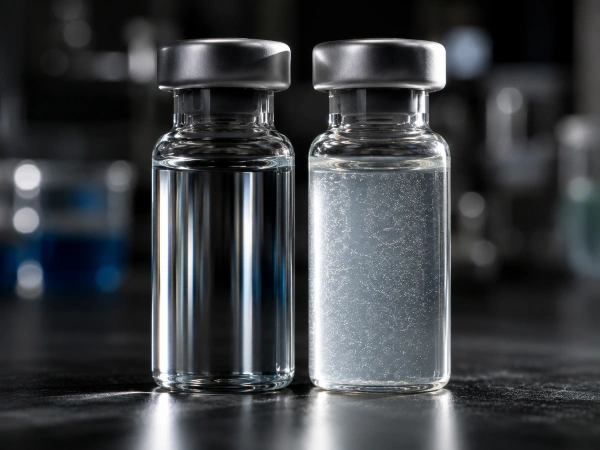
Aggregation is the most visible form of physical instability and one of the most common reasons a research preparation loses consistency between experiments. Aggregation generally begins when individual molecules adopt conformations that expose normally buried hydrophobic regions, which then associate to lower the system’s free energy.
What Drives Aggregation
Several conditions accelerate this process, and most of them are controllable in the laboratory:
- Elevated temperature. Warmer storage increases molecular motion and the population of partially unfolded states, raising collision frequency between aggregation-prone species.
- Agitation and shaking. Vortexing, pipette mixing, and transport vibration generate shear and expand interfaces, both of which promote unfolding at surfaces.
- Air-liquid and solid-liquid interfaces. Proteins adsorb readily at interfaces, where they can partially unfold and seed aggregate formation.
- High protein concentration. Crowding shortens the distance between molecules and increases the likelihood of intermolecular contact.
- Freeze-thaw cycling. Ice formation concentrates the protein in the unfrozen fraction and shifts local pH, creating conditions that favor association.
- Trace metal ions and pH extremes. Both can destabilize native structure and catalyze pathways that feed into aggregation.
Published stress-induced aggregation study work confirms that thermal, chemical, and interfacial stress each produce measurable recombinant HGH association, which is exactly why controlling these variables pays off.
Soluble Versus Insoluble Aggregates
Aggregation spans a continuum. At one end sit soluble dimers and small oligomers that may remain optically clear yet are detectable by size-based separation. At the other end sit larger insoluble particulates and visible precipitates. Some early associations are reversible upon dilution, while covalent or extensively rearranged aggregates are not. Distinguishing reversible from irreversible species matters when you interpret stability data, because a sample that appears acceptable by visual inspection can still carry a meaningful soluble aggregate burden. Monitor across the full size range rather than relying on appearance alone.
Deamidation and Charge Heterogeneity
Deamidation is the predominant chemical degradation route for recombinant HGH and the one most likely to introduce charge heterogeneity into an otherwise pure preparation. It proceeds through conversion of asparagine residues into a mixture of aspartate and isoaspartate, typically by way of a cyclic succinimide intermediate. Glutamine deamidation can also occur but generally proceeds far more slowly.
In recombinant HGH, asparagine residues in the C-terminal region of the sequence are the principal sites, with one position deamidating considerably faster than its neighbor. Each deamidation event adds a negative charge, so the population shifts toward more acidic variants over time. The succinimide intermediate hydrolyzes to a mixture that favors the isoaspartate form, which introduces a kink in the peptide backbone and can subtly alter local conformation.
Two storage variables dominate the rate of this reaction. Higher pH, particularly above neutrality, accelerates succinimide formation, and elevated temperature compounds the effect. Because deamidation alters the charge profile and local structure of the molecule, tracking charge variants is one of the more sensitive indicators of chemical change in a stored research preparation, a relationship documented in charge variant research on this protein. Keep formulation pH and storage temperature controlled and documented if you want to slow this pathway.
Additional Degradation Considerations
Aggregation and deamidation rarely act in complete isolation, so it helps to keep a few secondary routes in view. Methionine residues can oxidize to methionine sulfoxide, especially under light exposure or in the presence of oxidizing impurities. Backbone cleavage can produce lower molecular weight fragments, and disulfide bonds can scramble or reduce under certain conditions, which in turn can feed non-native aggregation. Each of these changes the analytical fingerprint of the material, so a complete stability assessment looks beyond the two primary pathways.
Storage Conditions That Influence Stability
Storage strategy is the single largest lever a research team controls. The right approach depends on the physical form of the material and the experimental timeline. Detailed lyophilized formulation research shows how molecular mobility in the dried state governs the rate of these degradation pathways.
Lyophilized Material
Freeze-dried recombinant HGH is generally the most stable form because the absence of bulk water suppresses both hydrolytic chemistry and diffusion-driven aggregation. Store lyophilized material cold and sealed, protect it from moisture and light, and allow vials to equilibrate to room temperature before opening to limit condensation. Reconstitute gently with the specified diluent, directing the stream against the vial wall rather than onto the powder, and avoid vigorous mixing. For a fuller routine, follow established lyophilized handling protocols.
Reconstituted Solutions
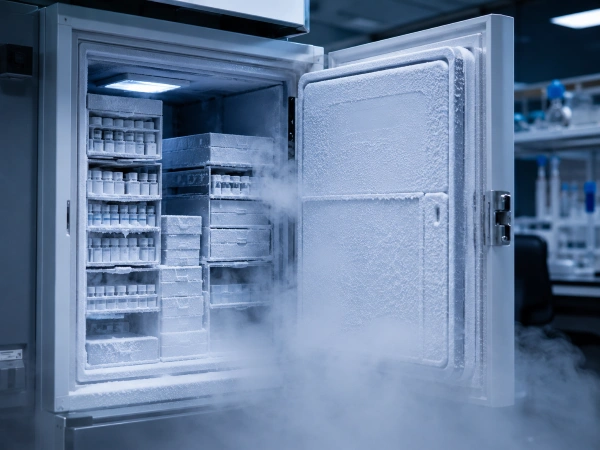
Once in solution, the material becomes more dynamic and more vulnerable. For short working windows, refrigerated storage between 2 and 8 °C is typical. For longer holds, lower temperatures such as -20 °C or -80 °C are commonly used, with the colder option generally preferred for extended periods. Buffer composition and pH strongly influence solution-phase stability, so keep these defined and consistent across a study, and review the guidance on choosing a solvent before reconstitution. In many research workflows a stabilizing carrier protein is added to dilute solutions to reduce surface losses and interface-driven aggregation.
Temperature, Freeze-Thaw, and Light
Repeated freeze-thaw is one of the most damaging routines a stored solution can experience. Prepare single-use aliquots immediately after reconstitution so that each experiment draws from a vial that is thawed only once. Protect solutions from light to limit photo-oxidation, and minimize agitation during handling and transport. When samples must move between locations, plan the cold chain and the physical packaging with the same care you give the experiment itself. Pair this handling with a routine for evaluating solution stability over time.
Analytical Methods to Monitor Stability
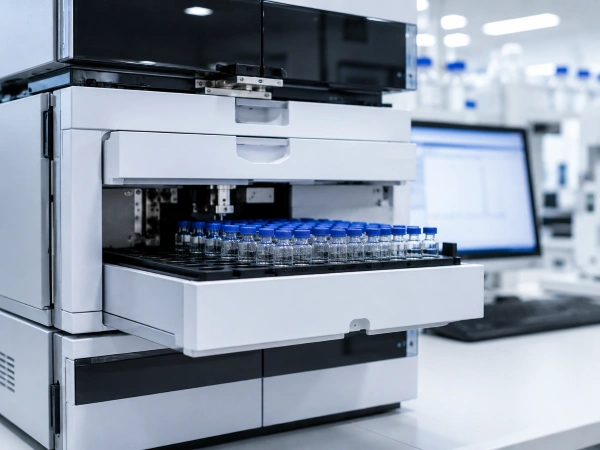
A stability program is only as good as the methods used to read it. Pair orthogonal techniques so that physical and chemical changes are both captured.
- Size exclusion chromatography (SEC-HPLC) resolves monomer, soluble aggregates, and fragments by hydrodynamic size.
- Reversed-phase HPLC (RP-HPLC) separates related substances, including oxidized forms.
- Ion exchange chromatography, capillary isoelectric focusing, or capillary zone electrophoresis profile charge variants and are well suited to detecting deamidation.
- SDS-PAGE provides a rapid visual check for fragments and covalent aggregates.
- Peptide mapping with LC-MS or LC-MS/MS localizes site-specific modifications such as deamidation and oxidation.
- Dynamic light scattering (DLS) flags early aggregation through changes in apparent size distribution.
- Circular dichroism and intrinsic fluorescence report on secondary and tertiary structure, while differential scanning calorimetry characterizes thermal stability.
Run a baseline panel when a lot arrives, then repeat the relevant subset at defined intervals or after any stress event. For a broader analytical method overview, see the companion methods guide. Consistent methods and timepoints make degradation trends interpretable rather than anecdotal.
Best Practices for Research Storage and Handling
Translate the science above into a standing protocol your team follows on every lot:
- Aliquot on arrival into single-use volumes to eliminate repeated freeze-thaw.
- Label completely, including lot, reconstitution date, buffer, and concentration.
- Hold temperature steady and avoid transient warming during handling.
- Control pH within the defined range to slow deamidation.
- Limit interfaces and agitation by handling solutions gently and filling containers appropriately.
- Document baseline characterization and keep the certificate of analysis on file as a reference point, and stay current on interpreting COA data.
- Schedule periodic re-analysis so stability is verified rather than assumed.
These steps cost little and protect the reproducibility that downstream research depends on.
Conclusion
Recombinant HGH rewards careful handling and punishes neglect, so build stability into your workflow from the first vial. Treat aggregation and deamidation as the two pathways most likely to erode data quality, and remember that you control the conditions that drive them. Keep lyophilized material cold, dry, and sealed, and treat every reconstituted solution as sensitive and short-lived. Aliquot on arrival to eliminate repeated freeze-thaw, hold temperature and pH steady, and shield solutions from light and agitation.
Pair these habits with orthogonal analytical methods so that physical and chemical changes surface early rather than mid-experiment, when they are far harder to trace. Document a baseline for each lot, schedule periodic re-analysis, and record every deviation. None of this is complicated, but it is the difference between reproducible results and wasted runs. Apply these protocols consistently and the material will perform predictably across the full life of your research program.
FAQs
How should lyophilized recombinant HGH be stored in the lab?
Store the sealed material cold, dry, and away from light, which keeps hydrolytic chemistry and aggregation slow. Let each vial reach room temperature before opening to limit condensation, then reconstitute gently against the vial wall. Confirm your conditions against the documentation supplied with the specific lot.
How long does reconstituted recombinant HGH remain stable in research storage?
Treat reconstituted solutions as sensitive and short-lived. Hold working volumes between 2 and 8 °C for near-term laboratory use, and move material to -20 °C or -80 °C for longer storage. Aliquot before freezing so no vial experiences more than one freeze-thaw cycle, and verify integrity analytically rather than assuming a fixed window. This is research handling guidance only and not a use or shelf-life claim.
What conditions cause recombinant HGH to aggregate?
Aggregation accelerates with elevated temperature, agitation and shaking, exposure at air-liquid and solid-liquid interfaces, high protein concentration, and repeated freeze-thaw. Minimize each variable by keeping samples cold and still, handling solutions gently, limiting headspace, and aliquoting to avoid freeze-thaw. Monitor across the full size range, since soluble aggregates can form before any visible haze appears.
Which residues in recombinant HGH are most prone to deamidation?
Asparagine residues in the C-terminal region are the principal sites, with one position reacting faster than its neighbor. The reaction proceeds through a succinimide intermediate and produces more acidic charge variants. Higher pH, especially above neutrality, and elevated temperature both speed it up, so control and document both throughout storage.
Which analytical methods confirm recombinant HGH stability?
Combine orthogonal techniques. Use size exclusion chromatography and dynamic light scattering for aggregates, ion exchange or capillary electrophoresis for charge variants tied to deamidation, reversed-phase HPLC for related substances, and peptide mapping with mass spectrometry for site-specific changes. Run a baseline panel on each new lot, then repeat the relevant subset at set intervals.
Disclaimer: All products and information referenced here are intended strictly for laboratory research and educational use by qualified professionals. Recombinant HGH and any related compounds discussed in this article are supplied for in vitro experimental purposes only.
These materials are not for human or animal consumption, ingestion, injection, or any in vivo use. They are not drugs, foods, dietary supplements, cosmetics, or medical devices, and they are not intended to diagnose, treat, cure, prevent, or mitigate any disease or health condition. No statement in this article has been evaluated by the Food and Drug Administration or any comparable regulatory authority, and nothing in it constitutes medical, clinical, veterinary, legal, or professional advice.
No part of this content should be read as encouraging, promoting, or endorsing any use outside of a controlled research environment. Any reference to research findings, analytical methods, or third-party publications is provided for informational and educational context only and does not imply any particular outcome.
By accessing this information or purchasing these materials, you confirm that you are a qualified researcher or institution and that you will handle, store, transport, and dispose of all materials in accordance with applicable local, state, federal, and institutional regulations. The buyer assumes full responsibility for the lawful and appropriate use of any product obtained, and these materials may not be resold or redistributed for any purpose other than legitimate scientific research.