
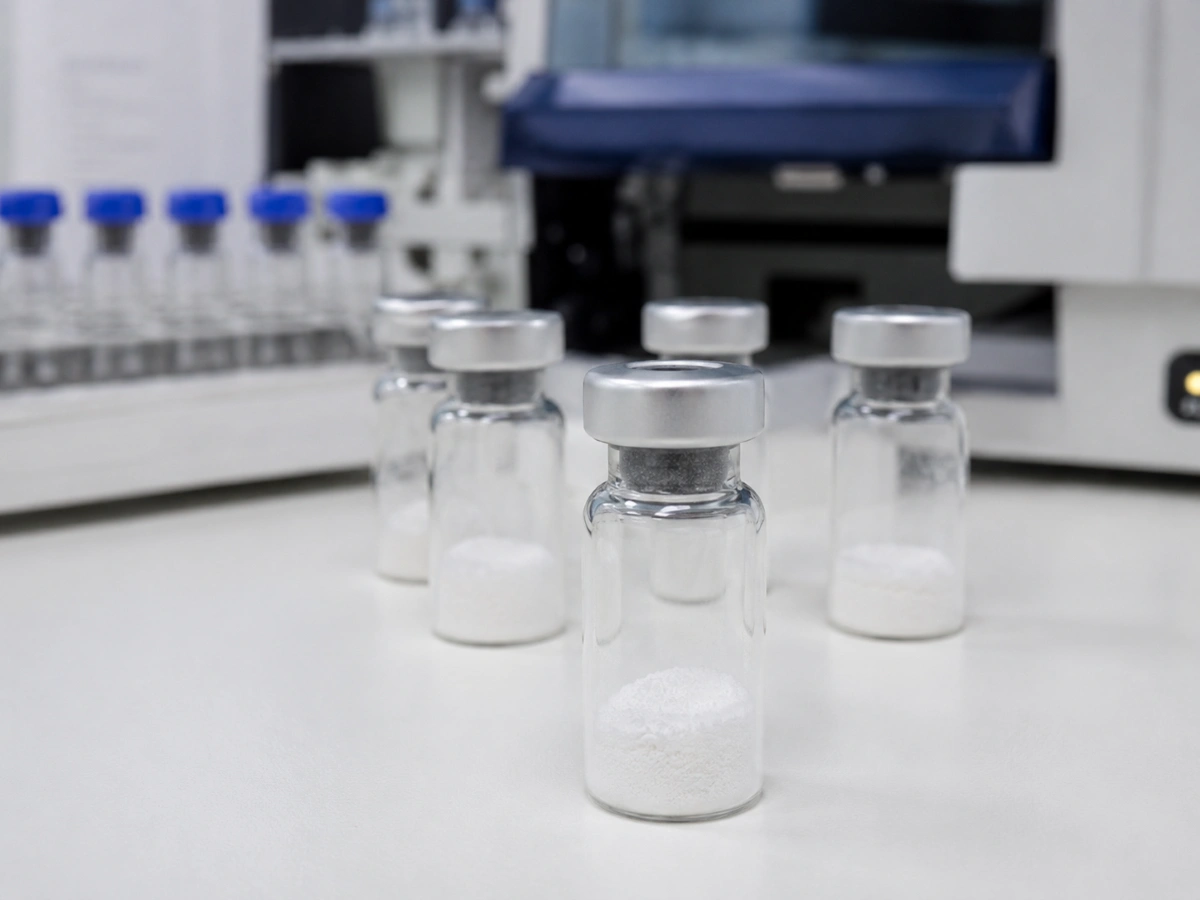
Written By: Gary Hite, Research Content Writer
Reviewed By: Natalie Kunsman, M.D., Board-Certified Physician
Last Reviewed: September 2, 2026
For research use only. Not for human consumption.
When a research peptide arrives labeled as an acetate salt, the counterion printed on that label is doing more work than it first appears. For anyone preparing to weigh, reconstitute, or store Hexarelin Acetate at the bench, the acetate portion of the compound directly shapes how the material behaves in solution, how accurately it can be measured, and how consistently results hold up across repeated experiments. Reviewing the counterion before the vial is even opened is one of the simplest steps a researcher can take to protect data quality.
This article explains why peptides such as Hexarelin are commonly supplied in an acetate salt form, how counterion choice influences net peptide content and stability, and which practical habits support careful handling in a laboratory environment. Every point below is intended for professional researchers and academic use only.
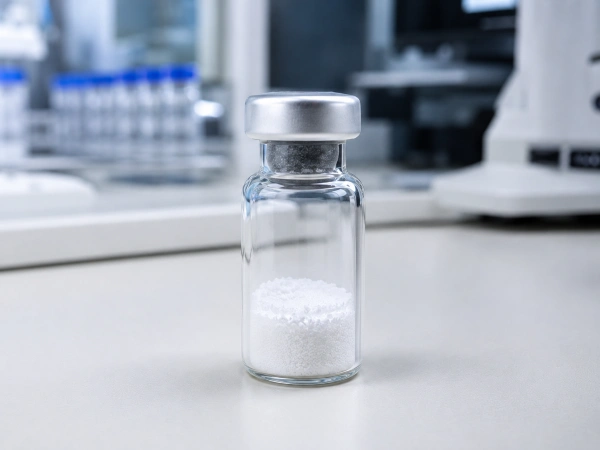
What a Counterion Is and Why Peptides Carry One
Most peptides contain ionizable groups, including the N-terminus, the C-terminus, and the side chains of residues such as lysine, arginine, histidine, aspartate, and glutamate. At the pH conditions used during isolation and purification, these groups carry a net electrical charge. To produce a neutral, stable, isolable solid, that charge is balanced by oppositely charged ions known as counterions.
Hexarelin is a synthetic hexapeptide that carries basic functionality, so it is typically recovered and supplied as a salt rather than as a free base. When the counterion is acetate, the material is described as Hexarelin Acetate. The peptide sequence remains the same regardless of the salt form, but the accompanying counterion changes several practical properties that matter at the bench.
Why Acetate Is a Common Salt Form for Research Peptides
The salt form a peptide carries is usually a product of how it was synthesized and purified. Solid-phase peptide synthesis followed by reverse-phase high performance liquid chromatography frequently leaves the peptide associated with trifluoroacetate, since trifluoroacetic acid is a common mobile phase additive. To move away from that residual counterion, a counterion exchange step can be performed to convert the peptide into an acetate salt.
Acetate is selected for research material for several reasons. It is a small, volatile organic anion, which means controlled amounts can be removed during lyophilization. It is broadly compatible with many aqueous buffer systems used in laboratory work. And in assay design, acetate is often viewed as a lower interference counterion compared with certain alternatives. These characteristics make the acetate salt a frequent default for peptides destined for research and analytical applications.
How Counterion Choice Affects Net Peptide Content
This is the concept that most often catches researchers off guard, so it deserves direct attention. The mass weighed out of a vial is not pure peptide. It is the sum of the peptide, its counterions, and any water the solid has retained. As a result, a given quantity of acetate salt does not contain an equal mass of bare peptide.
The fraction of the total mass that is actually peptide is referred to as the net peptide content, or peptide content by mass. For accurate molar concentration calculations, this value cannot be ignored. Treating the full weighed mass as if it were pure peptide will overstate concentration and skew any downstream calculation that depends on it.
The practical response is straightforward. Locate the net peptide content on the certificate of analysis, and factor it into every concentration and molarity calculation. Recording this value alongside the lot number in the laboratory notebook makes it far easier to reproduce conditions later and to compare results across batches that may carry slightly different salt and water content.
Solubility and Reconstitution at the Bench
Acetate salts of basic peptides generally dissolve well in water and in common aqueous buffers, which is part of their appeal for research preparation. Even so, solubility behavior can depend on concentration, buffer composition, and pH, so it is worth confirming that the chosen vehicle is appropriate for the planned work before committing a full vial.
When reconstituting, choosing the reconstitution solvent thoughtfully matters: add it gently along the side of the vial rather than directly onto the lyophilized material, and allow the solid to dissolve without aggressive agitation. Document the solvent, the volume, and the resulting concentration at the time of preparation. Consistent reconstitution practice reduces variability between preparations and makes results easier to interpret.

Stability, Hygroscopicity, and Storage
Counterion identity influences how a peptide solid behaves during storage. Acetate salts can be hygroscopic, meaning they readily take up moisture from the surrounding air. Absorbed water adds to the weighed mass and can compromise weighing accuracy, and over time moisture exposure can work against solid-state stability.
A few handling habits address this directly. Following sound storage protocols, store the lyophilized material as recommended for the specific lot, typically cold, sealed, protected from light, and kept away from humidity. Before opening a cold vial, allow it to equilibrate to room temperature so that condensation does not form on or inside the container. When weighing, work efficiently to limit the time the solid is exposed to ambient air. For solutions, prepare them as close to the time of use as the experimental design allows, and store any aliquots according to documented stability information rather than assumption.
Acetate Compared With Trifluoroacetate in the Laboratory
Because many peptides begin as trifluoroacetate salts, researchers often weigh the relative merits of the two counterions for a given application. Residual trifluoroacetate can interfere with certain cell-based assays and can complicate some analytical readouts, and published work on trifluoroacetate removal has compared several exchange approaches. This is one reason the acetate salt form is frequently preferred where assay sensitivity to the counterion is a concern.
The important discipline here is verification rather than assumption. The salt form should be confirmed from analytical documentation, not inferred from the product name alone, since residual counterion levels depend on how thoroughly any exchange and purification steps were carried out.
Verifying Counterion Identity and Content
Several analytical methods are used to characterize the salt form and overall composition of a peptide. Ion chromatography and capillary electrophoresis are commonly applied to quantify acetate, while ion chromatography or fluorine nuclear magnetic resonance can assess residual trifluoroacetate. Reverse-phase high performance liquid chromatography reports chromatographic purity, mass spectrometry confirms identity, and Karl Fischer titration measures water content, which ties directly back to weighing accuracy.
For quantitative research, the action is to request and review the certificate of analysis before beginning work. Confirm the stated counterion, the chromatographic purity, the net peptide content, and the water content, and keep that record on file with the corresponding lot.

Documentation and Good Research Practice
Reproducibility depends on accounting for the details that quietly shift results, and salt form is one of them. Capturing the counterion, net peptide content, purity, water content, and lot number in the laboratory record turns those values into a usable reference. When a later experiment needs to match earlier conditions, or when results from two batches need to be compared, that documentation is what makes a fair comparison possible.
A Short Handling Checklist
- Read the certificate of analysis and note the counterion, purity, net peptide content, and water content.
- Factor net peptide content into every concentration and molarity calculation.
- Equilibrate cold vials to room temperature before opening to avoid condensation.
- Weigh efficiently to limit moisture uptake by hygroscopic solids.
- Reconstitute gently with an appropriate research-grade solvent and record the details.
- Store the material and any aliquots according to documented conditions.
Conclusion
Counterion choice rarely makes it onto a research checklist, yet it quietly governs how a peptide weighs, dissolves, stores, and performs in an assay. Treat the acetate salt form on the label as working information rather than a footnote, and the payoff shows up as cleaner data and results that others can reproduce. Before the first experiment, pull the certificate of analysis and confirm the counterion, chromatographic purity, net peptide content, and water content.
Carry the net peptide value into every concentration and molarity calculation, reconstitute with a documented research-grade solvent, and store both the solid and any aliquots under conditions matched to the lot. Record these details in the laboratory notebook so future work aligns to the same baseline. Handled this way, Hexarelin Acetate becomes a predictable input rather than a source of avoidable variability. Sourcing well-documented research peptides and pairing them with disciplined handling protects the integrity of everything downstream.
FAQs
What does the “acetate” in Hexarelin Acetate refer to?
Acetate is the counterion paired with the peptide to keep the solid electrically neutral. It does not change Hexarelin’s amino acid sequence, but it does influence solubility, weighing accuracy, and assay compatibility. Read the product label and the accompanying certificate of analysis so you know exactly which salt form you are working with before any quantitative work begins.
Why is Hexarelin offered as an acetate salt rather than another salt form?
Solid-phase synthesis followed by reverse-phase purification typically leaves peptides as trifluoroacetate salts, so a counterion exchange step is used to convert the material to an acetate salt. Acetate is a small, volatile, broadly buffer-compatible anion that is often viewed as lower interference in assay work. Confirm the stated counterion from the certificate of analysis rather than assuming it from the product name.
Does the acetate salt form change how much peptide I actually weigh out?
Yes. The mass on the balance includes the peptide, its acetate counterions, and any retained water, so a given weight of salt is not an equal weight of bare peptide. Locate the net peptide content on the certificate of analysis and apply it to every concentration and molarity calculation so your reported values stay accurate.
How should Hexarelin Acetate be stored in the laboratory?
Keep the lyophilized material cold, sealed, protected from light, and away from humidity, following the conditions specified for the lot. Allow a cold vial to reach room temperature before opening so condensation does not form, and weigh efficiently because acetate salts can be hygroscopic. Prepare solutions close to the time of use and store any aliquots according to documented stability information.
How can I verify the counterion identity and purity of a research peptide?
Start with the certificate of analysis, then match its claims to recognized analytical methods. Ion chromatography or capillary electrophoresis quantifies acetate, ion chromatography or fluorine nuclear magnetic resonance checks for residual trifluoroacetate, reverse-phase HPLC reports chromatographic purity, mass spectrometry confirms identity, and Karl Fischer titration measures water content. Verify these values rather than assuming them, and keep the records on file with the corresponding lot.
Research Use Disclaimer: Hexarelin Acetate is sold and intended strictly for laboratory research and educational purposes. It is not a drug, food, dietary supplement, or cosmetic, and it is not intended to diagnose, treat, cure, or prevent any disease or condition. It is not for human consumption, human use, veterinary use, or any application in humans or animals outside of properly authorized and regulated research settings. All handling should be performed only by qualified professionals trained in laboratory safety, and in full accordance with applicable institutional, local, state, and federal regulations. Nothing in this article constitutes medical, clinical, or professional advice, and nothing here should be interpreted as encouraging any use of this material outside of a compliant research context.